
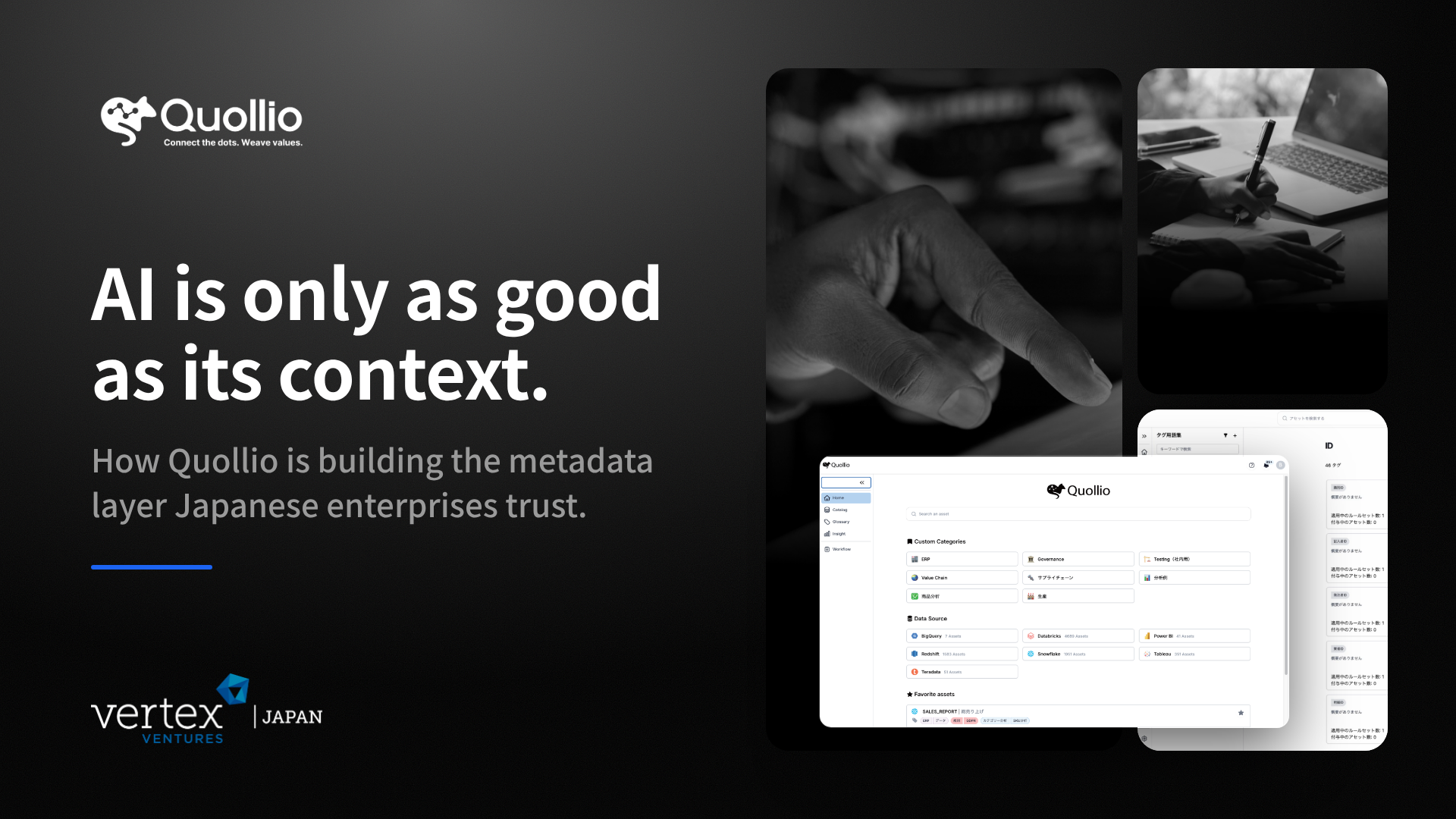
Every large company in Japan can tell you how much data it has. Very few can tell you what all of it means.
Ask a simple question inside a global manufacturer, such as how much inventory is sitting offshore right now, and the answer depends on who you ask. One business unit counts stock when it ships. Another counts it when it lands. A third recognises revenue on a different date again. Each system is correct on its own terms. Put them side by side and the numbers disagree, so somebody opens Excel and reconciles them by hand.
That somebody used to be the bottleneck. Increasingly, it is an AI model. And unlike the analyst who has worked there for fifteen years, the model has no idea that “inventory” means three different things in three different divisions. It simply guesses.
This is the problem Quollio Technologies was founded to solve.
Rich in data, short on context
Over the past decade, Japanese enterprises have invested heavily in moving their data to the cloud. Warehouses such as Snowflake, Databricks and BigQuery now sit alongside decades of ERP systems, and dashboards in Tableau and Power BI sit on top of both. Storage is no longer the constraint.
Understanding is. What a table contains, who owns it, how a column was calculated, whether it can be trusted, which report it feeds: this information about data, its metadata, usually lives in people's heads, in scattered spreadsheets, or nowhere at all. When a key employee moves on, the knowledge goes with them.
For years this was an expensive inconvenience. In the age of generative AI it has become a strategic one. Large language models are remarkably capable, but they reason only from the context they are given. Point an AI agent at a warehouse full of cryptically named tables and it will produce confident answers built on definitions it has invented. The quality of enterprise AI, in other words, is capped by the quality of enterprise metadata.
Auditors who saw the problem first
Quollio's founders met the problem in its purest form: as auditors.
CEO Ryota Matsumoto, a graduate of Osaka University's economics faculty, worked in audit data analytics at KPMG AZSA, where he helped build company-wide data analysis infrastructure. Co-founder, Executive Vice President and COO Takahiro Sanada, who holds a master's degree in applied physics from Waseda University, worked alongside him as a data scientist after years as a systems engineer and analytics consultant.
Audit is the discipline of asking whether a number can be trusted, and tracing it back to its source. Again and again, the two found that the hard part was not the analysis. It was working out what the data actually meant before any analysis could begin.
They founded Quollio in Tokyo in August 2021 with a mission to connect the world's information and knowledge to drive new value creation, captured in the company's tagline: Connect the dots. Weave values. CTO and VP of Product Yoshinori Tahara now leads the product, and the team has grown to one where roughly 45% of employees are global talent.
One metadata layer for people and AI
Quollio's platform, the Quollio Data Intelligence Cloud, gives an enterprise a single place to collect, organise and govern its metadata. It connects to the systems companies already use, including Snowflake, Databricks, BigQuery, Redshift, Teradata, Tableau and Power BI, and builds a shared catalog of what every dataset is, where it came from and who is responsible for it. Governance, lineage and data quality sit in the same place rather than in separate tools.
Three design choices set it apart.
First, it is built for how Japanese enterprises work. The interface, workflows and support are designed around Japanese business practice and language, and properties can be configured to each organisation, so business definitions, not just technical ones, can be captured. New features such as the Metadata Lifecycle Manager, launched in March 2026, are aimed at a practical goal: keeping metadata current without placing an unsustainable burden on frontline staff.
Second, it is vendor-neutral. Quollio does not sell a data warehouse, an ETL tool or a BI product of its own, so it has no reason to steer customers towards any particular stack. That neutrality matters in large organisations where every division has made different technology choices.
Third, it is built for AI as well as people. In August 2026, Quollio made its MCP server generally available, using the Model Context Protocol so that AI tools such as Claude, Gemini CLI and Microsoft Copilot Studio can read and update catalog metadata in real time. An agent can look up what a table means before it queries it, draft descriptions for new data sources for a data steward to approve, or flag unused assets for archiving. The catalog stops being documentation people occasionally consult and becomes context that AI uses every time it works.
Matsumoto describes the shift directly. In his 2026 New Year message, he wrote that the central question for enterprises is no longer whether to use AI, but how to evaluate it, how to trust it, and how far to entrust it with judgment. His answer is to redefine Quollio as “a textbook for AI”: the trusted body of business knowledge that AI learns from before it acts.
To help companies get there, Quollio launched Quollio INTEGRAL in February 2026, a professional services offering that runs from data and AI governance strategy through implementation and metadata enrichment, to proof-of-concept work that measures how much better AI answers become when metadata is in place.
From pilots to production
The customer list shows how far the idea has travelled. Quollio is used by companies including KDDI, Hakuhodo Technologies, ENEOS, Epson, Fuji Yakuhin, Infomart and Yanmar.
Yanmar, which runs agricultural, construction, marine and energy businesses worldwide, is a clear example. Its business units each ran their own systems, data formats differed, and some teams reconciled figures manually in Excel. Yanmar adopted Quollio to improve global supply chain management and to build a data foundation that AI can interpret. Definitions such as revenue recognition timing and categories like offshore inventory are now documented as metadata, so analysts in its first division to go live can run production, sales and inventory analysis without ambiguity. Yanmar cited a domestic vendor with an intuitive interface, clear pricing that does not grow with usage, a rich API for AI integration, and hands-on support from planning to rollout.
Independent research points the same way. According to ITR's Market View: DBMS/BI 2026, published in January 2026, Quollio ranked second by revenue share in Japan's data catalog market in fiscal 2024 and is forecast to hold that position in fiscal 2025, and is forecast to rank first in both the manufacturing and the information and communications sectors.
Quollio has also built a partner network that reaches deep into Japanese enterprise IT. NTT DATA signed a solution partner agreement in April 2025, positioning metadata as a way to improve the speed and quality of AI agent-driven work. Teradata Japan, NEC and, in October 2026, ITOCHU Techno-Solutions have followed, with NEC and Quollio completing technical validation of a context layer that manages machine learning features alongside their business meaning.
The company has raised more than ¥1 billion to date, including a ¥750 million Series A in June 2024 led by DNX Ventures.
Where Vertex Ventures Japan comes in
Three things drew us to the company.
The first is timing. Every large company in Japan is now under pressure to put generative AI to work, and almost every one of them is discovering the same obstacle: AI cannot use data it does not understand. Metadata management has moved from a back-office hygiene task to the foundation of enterprise AI, and Quollio was already there when the market arrived.
The second is fit with the Japanese market. Global catalog tools exist, but large Japanese enterprises buy differently, operate differently and document their businesses in Japanese. A product designed from the start for that reality, with a partner network that includes NTT DATA and ITOCHU Techno-Solutions, has a structural advantage that is hard to copy.
The third is what the platform accumulates. Each customer that documents its business definitions in Quollio is building a structured record of how the company actually works. As AI agents increasingly read from and write to that record, it becomes harder to replace and more valuable over time.
“AI is only as good as the context it is given. Quollio has built the metadata layer that Japanese enterprises trust, and is now connecting it directly to AI agents. We are proud to back Ryota and the team as they make Japan's data ready for AI.”
Naonori Kurokawa
General Partner
Vertex Ventures Japan
Vertex Ventures Japan backs founders building companies that solve hard problems in Japan and matter globally. Quollio's problem is not unique to Japan. Every enterprise in every market that wants to trust its AI will first have to explain its business to it.
Quollio intends to be where that explanation is written.
For more information on Quollio, visit:
https://quollio.com/