
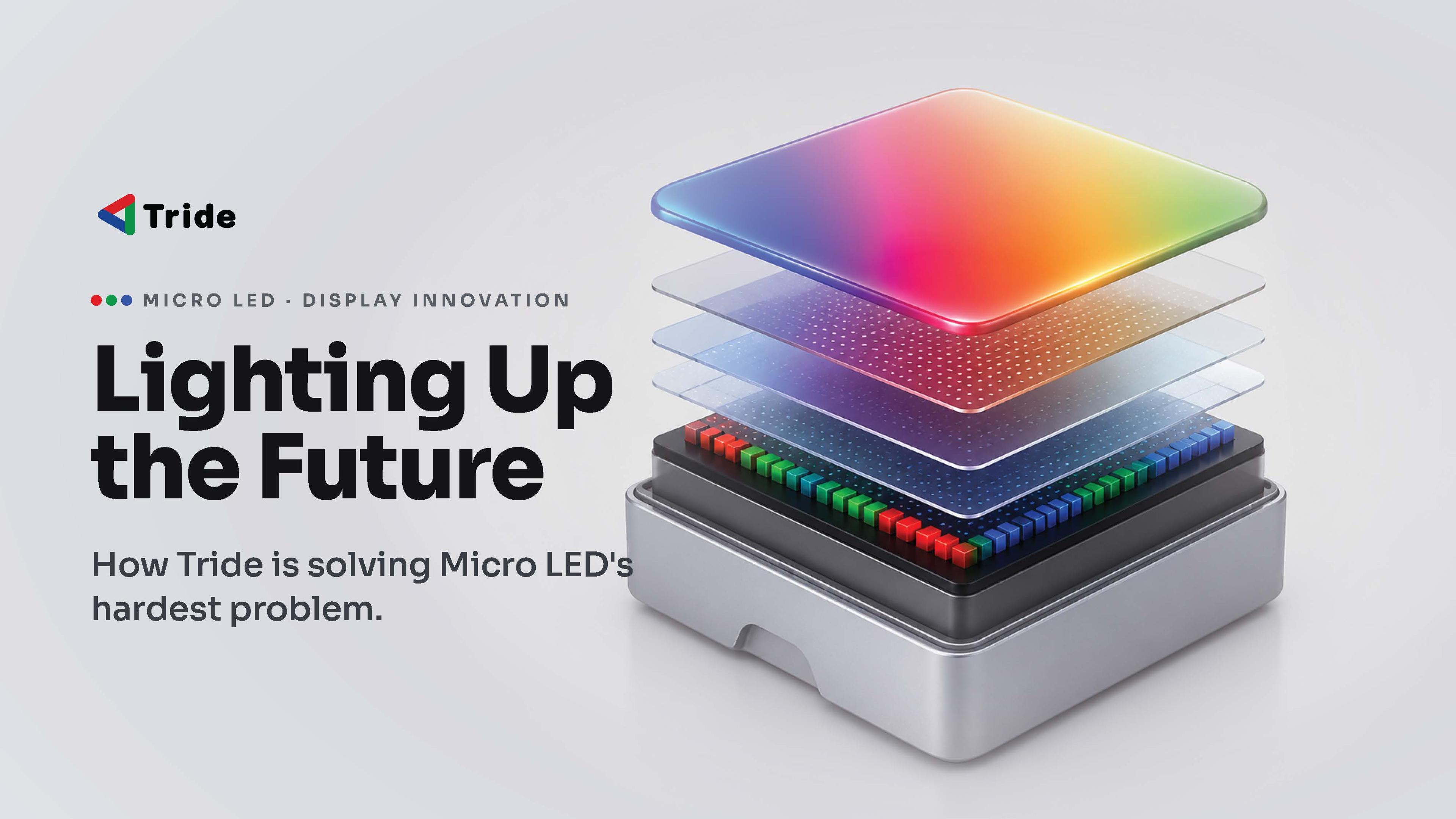
Every screen we look at, from the phone in our pocket to the panel in our car, rests on display technology that has changed remarkably little in principle over the past two decades. Vertex Ventures Japan has invested in Tride Inc., a deep-tech startup working to change that, with a technology that reaches beyond the pixel as we know it.
The promise, and the problem, of micro LED
Micro LED has long been regarded as the display technology of the future. It offers what every display maker wants at once: higher brightness, deeper contrast, greater energy efficiency, and a far longer lifespan than the OLED and LCD panels in use today.
Yet one obstacle has held the entire category back: color. Producing a full-color micro LED display has traditionally meant growing red, green, and blue emitters from different materials, then transferring millions of microscopic chips onto a single panel. This mass-transfer step is slow, costly, and difficult to scale, and it has kept micro LED out of reach for most mainstream applications. Solve color, and the format finally opens up.
A different approach: full color from a single chip
Tride's answer is monolithic full-color micro LED. Rather than assembling a display from three separately manufactured color chips, Tride generates red, green, and blue on a single continuous semiconductor structure. The color is built into the device itself, removing the need to transfer individual color chips one by one.
The approach is rooted in years of nitride-semiconductor research and attacks precisely the bottleneck that has constrained the whole industry. Fewer process steps, tighter pixel densities, and a clearer path to manufacturing at scale.
Why it matters
Monolithic micro LED matters most where today's displays fall short. In augmented and virtual reality, it enables displays bright enough to use outdoors and dense enough to sit just millimeters from the eye. In wearables and automotive applications, it offers efficiency and durability that current technologies struggle to match. And as displays continue to shrink and grow more pixel-dense, an architecture that does not depend on transferring individual chips becomes not merely cheaper, but essential. This is foundational technology, not an incremental upgrade.
A team built for hard technology
Tride brings together a founding team with exactly what deep tech demands: world-class research paired with deep industry experience. CEO Tatsuhito Sakamoto spent eight years at ROHM Semiconductor's Silicon Valley office serving major technology companies, and leads strategy and ecosystem building. COO Hironori Miyauchi, a University of Tokyo Ph.D. with experience at QD Laser and GITAI, oversees business development and operations. CTO Koji Okuno, a Nagoya University Ph.D. formerly at Toyoda Gosei, brings deep R&D experience across blue LEDs, laser diodes, and micro LED. Anchoring the science is CSO Prof. Motoaki Iwaya of Meijo University, a globally recognized authority in nitride semiconductor devices, who leads joint research and IP strategy.
The Vertex view
Tride is exactly the kind of hard-tech, long-horizon company Vertex Ventures Japan was built to support: turning frontier Japanese research into globally relevant businesses. We are proud to back the Tride team, and excited for the journey ahead.